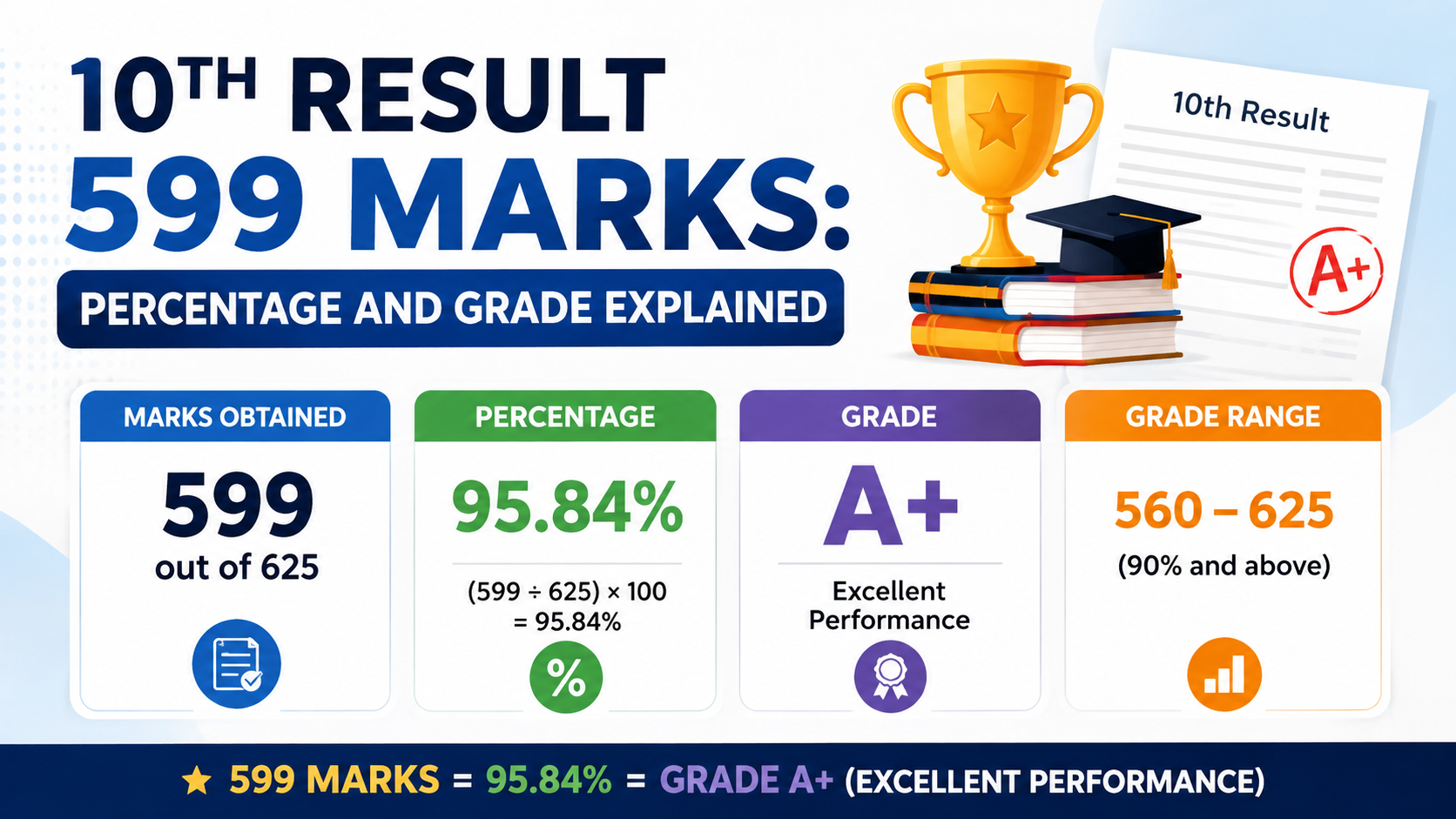
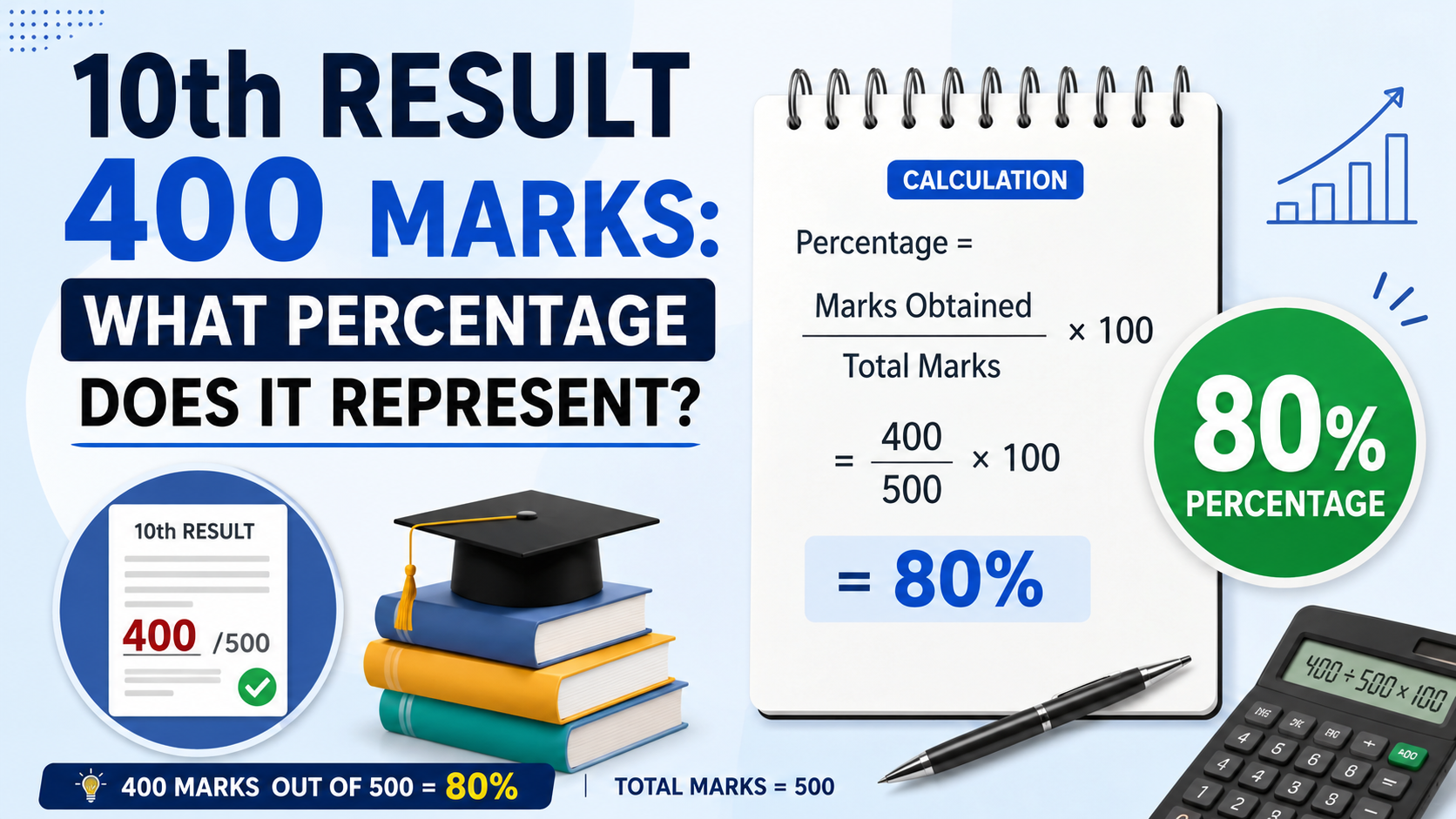
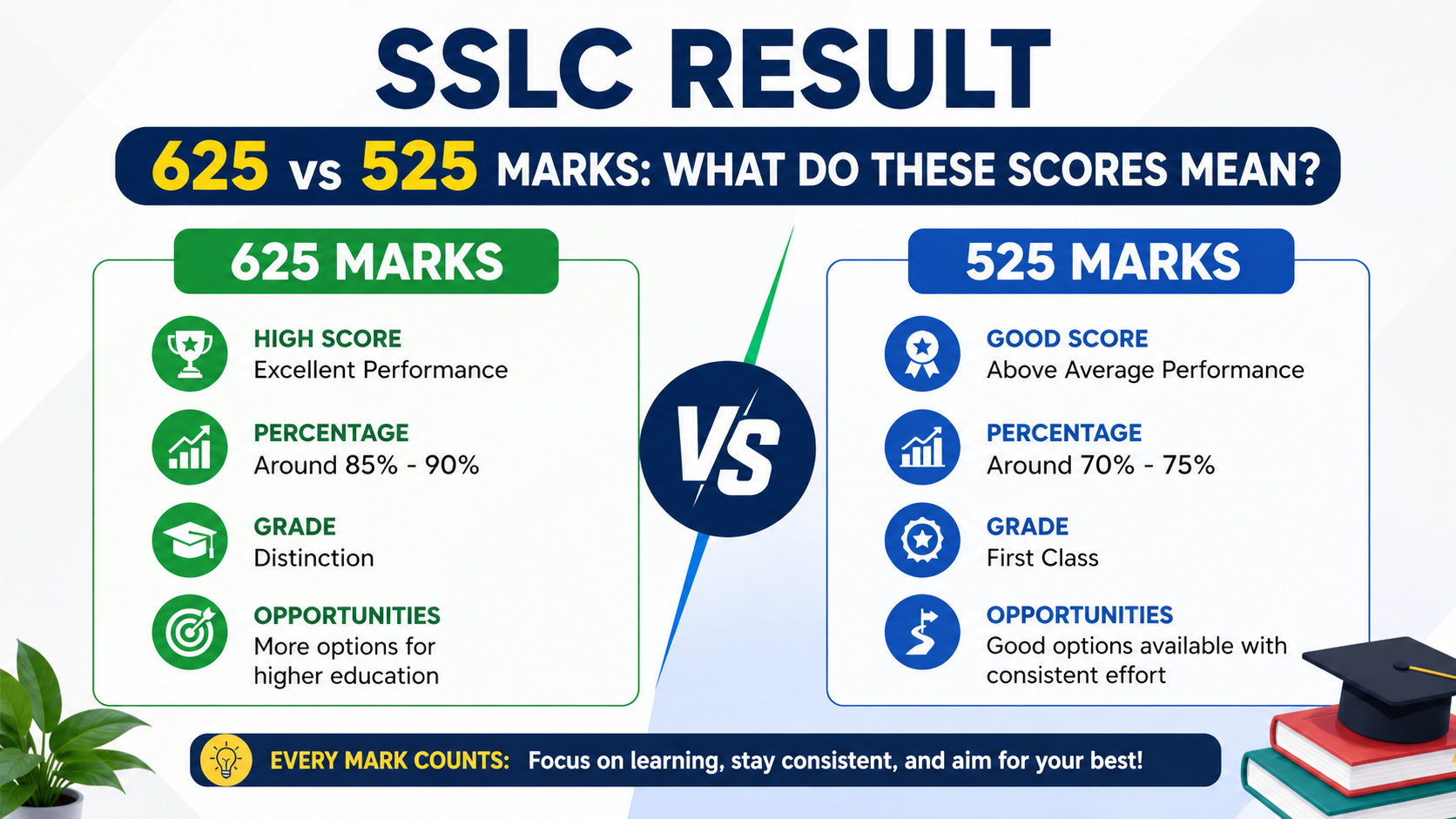
If you are searching for sslc result how to calculate percentage, the correct method is simple: add the marks that are officially included in your total, divide by the maximum marks for those same subjects, and multiply by 100.
The important part is choosing the right total. SSLC rules and mark formats can differ by state board and may change by academic year. For Karnataka SSLC 2026, use the maximum marks and subjects shown on your own official result or marks card—not an old marks pattern, an online calculator with unknown settings, or a social-media post.
Karnataka School Examination and Assessment Board (KSEAB) published the SSLC 2026 Examination-1 result on 23 April 2026 and the consolidated Exam-1 and Exam-2 best-marks result on 30 May 2026 through the official Karnataka results portal. The portal also states that online results are for immediate information and are not a substitute for the original marks sheet. Official Karnataka results portal
Key Takeaways
- Percentage =
(marks obtained ÷ maximum marks) × 100. - Add only subjects that carry numerical marks and are included in the official aggregate.
- Use the maximum total printed on your SSLC 2026 marks card; do not automatically assume a denominator such as 500, 525, or 625.
- Keep grades, absent status, and non-numerical subjects out of a marks-based calculation unless the board or receiving institution gives a written conversion rule.
- If you appeared for multiple KSEAB examinations, use the marks shown on the relevant official consolidated result or marks card.
- Round only at the final step, unless an application form specifies a different rule.
Understand What Your SSLC Percentage Represents
A percentage converts your aggregate marks into a score out of 100. It helps schools, colleges, scholarship portals and employers compare results even when their maximum marks differ.
For example, 420 out of 500 and 441 out of 525 are not the same number of marks, but both equal 84%.
Your SSLC percentage is useful only when it is calculated from the exact marks and maximum marks requested. An admission form may ask for:
- Overall percentage
- Percentage in all subjects
- Percentage in best five subjects
- Percentage excluding a third language or a grade-only subject
- Percentage for eligibility subjects only
Do not treat these as interchangeable. Read the form’s instructions before entering a percentage.
The SSLC Percentage Formula
Use this formula:
Percentage = (Total marks obtained ÷ Total maximum marks) × 100
For a reliable calculation, both numbers must cover the same set of subjects.
| Item | What to use |
|---|---|
| Total marks obtained | Add your numerical marks in the included subjects |
| Total maximum marks | Add the maximum marks for those exact subjects |
| Final calculation | Divide obtained marks by maximum marks, then multiply by 100 |
Example: Marks Out of 500
Suppose your included subjects show:
| Subject | Marks obtained | Maximum marks |
|---|---|---|
| First language | 82 | 100 |
| English | 76 | 100 |
| Mathematics | 91 | 100 |
| Science | 84 | 100 |
| Social Science | 87 | 100 |
| Total | 420 | 500 |
Calculation:
(420 ÷ 500) × 100 = 84%
Your percentage is 84%.
Example: Unequal Maximum Marks
Not every SSLC marks card necessarily uses the same maximum marks for every subject. If your included subjects total 525 maximum marks and you obtained 438, calculate:
(438 ÷ 525) × 100 = 83.428...
Rounded to two decimal places, your percentage is 83.43%.
The method stays the same even when subjects have different maximum marks.
How to Calculate Your Percentage From the SSLC 2026 Marks Card
Follow these steps after viewing or downloading your official result.
1. Identify the Correct Result Record
Use the official result page and enter the requested details exactly as shown on your admission ticket. For Karnataka SSLC, the official result interface asks for the registration number and date of birth. KSEAB SSLC 2026 Exam-1 result page
If you have taken more than one examination, make sure you are using the result record relevant to your purpose. KSEAB’s official portal has separately listed the SSLC 2026 Examination-1 result and a consolidated Exam-1 and Exam-2 best-marks result. Consolidated SSLC 2026 result page
2. List Only Numerical Marks Included in the Aggregate
Copy each included subject’s marks and its maximum marks into a notebook, spreadsheet, or calculator.
Do not add a subject merely because it appears on the marks card. First check whether it has:
- A numerical score that counts toward the total
- A grade instead of marks
- An “absent,” withheld, or other status
- A separate internal-assessment component already included in the displayed subject total
If a subject is grade-only, do not invent numerical marks for it.
3. Add the Obtained Marks
Add all included numerical marks. Check the addition twice, especially when a subject contains theory, practical, project, or internal-assessment components.
If the marks card already displays an official total for the same included subjects, compare your sum with it. The official displayed total is the safer figure to use.
4. Add the Corresponding Maximum Marks
Add the maximum marks for exactly the subjects you counted in Step 3.
This is where many percentage calculations go wrong. If you exclude one subject from the marks obtained, you must also exclude that subject’s maximum marks.
5. Apply the Formula and Round at the End
Divide your total marks by the total maximum marks, multiply by 100, and round only after completing the calculation.
For instance:
Marks obtained: 456
Maximum marks: 525

(456 ÷ 525) × 100 = 86.857...
Percentage = 86.86%
Which Maximum Total Should You Use?
There is no universal SSLC maximum total for all Indian boards, schools, or years. Even within one board, the treatment of languages, internal assessment, electives, and grading can affect the aggregate.
For SSLC Result 2026, the safest rule is:
Use the total maximum marks that matches the numerical subjects included on your official marks card or the exact requirement of the application form.
Do Not Assume an Old Pattern Applies
Students often find different totals quoted online. A total from an earlier SSLC batch, another state board, or a different subject combination may not apply to your marks card.
Avoid these mistakes:
- Dividing by 625 because a previous batch used that total
- Dividing by 500 when your included subjects total a different maximum
- Including a grade-only subject as if it were marked out of 100
- Calculating “best of five” when the form asks for all subjects
- Using a coaching-centre or unofficial website result as proof of marks
When there is any uncertainty, rely on the marks card and ask your school or the institution receiving your application which calculation it accepts.
Grades, Marks and Percentage Are Not the Same
A grade communicates a performance band; a percentage is an exact calculation from marks. They should not be treated as identical unless the relevant board or institution has published an official conversion method.
For example, a grade may cover a range of marks. Turning that range into one exact percentage without an authorised conversion can create an inaccurate figure.
When a Grade Conversion May Be Needed
You may need a grade conversion only when an application specifically asks for a percentage but your certificate provides grades rather than aggregate numerical marks.
In that situation:
- Read the application instructions.
- Check whether the board has issued an official conversion formula.
- Use that formula only if it applies to your certificate and examination year.
- If no official conversion is provided, contact the institution or your school before submitting the form.
Never assume that a CBSE, ICSE, state-board, or university conversion formula applies to Karnataka SSLC or another SSLC board.
Percentage Calculation for Admissions, Scholarships and Forms
An online application can reject or flag a form if your percentage does not match its stated method. Before submitting, check these points.
All Subjects vs Best Five
“Best five” means you select the five eligible subjects with the highest marks, then calculate both obtained and maximum marks using only those five subjects. Do this only when the form explicitly says “best five.”
For example:
Best-five marks obtained: 448
Best-five maximum marks: 500

(448 ÷ 500) × 100 = 89.6%
Do not present this as your overall SSLC percentage if the institution asks for all included subjects.
Passing Status Is Separate From Percentage
A high overall percentage does not automatically override subject-wise pass requirements. Similarly, a pass result does not tell you the exact percentage. Read both the result status and the marks details.
Use the Same Rounding Rule as the Form
If the form asks for two decimal places, enter two decimal places. If it accepts only whole numbers, follow its instructions rather than rounding in a way that changes eligibility.
For example, 79.995% may be treated differently depending on whether the institution rounds to 80.00%, truncates it to 79.99%, or requires the exact calculated value.
Common SSLC Percentage Calculation Errors
The calculation is easy; using mismatched numbers is the real problem.
| Error | Why it is wrong | Correct approach |
|---|---|---|
| Dividing by a guessed total | The total may not match your marks card | Add the maxima of included subjects |
| Converting a grade into arbitrary marks | A grade may cover a range | Use an official conversion only |
| Including excluded subjects | It distorts the aggregate | Follow the marks card or form instructions |
| Using only theory marks | Internal or practical marks may already be part of the total | Use the final subject marks shown |
| Rounding each subject or intermediate result | Small errors can accumulate | Round only the final percentage |
| Calling an online result the final certificate | Official portals may label it provisional or informational | Preserve and use the original marks sheet when issued |
Frequently Asked Questions
How do I calculate my SSLC percentage in 2026?
Add the numerical marks that officially count toward your aggregate, divide by the maximum marks for those same subjects, and multiply by 100. For example, 438 out of 525 is (438 ÷ 525) × 100 = 83.43%.
Can I divide my SSLC marks by 625?
Only if the included subjects on your own marks card total 625 maximum marks or the institution specifically instructs you to use 625. Do not use 625 automatically; SSLC totals can differ by board, year, and marks structure.
Should I include a grade-only language subject in my percentage?
Usually, do not assign marks to a grade-only subject unless the board or the application has issued an applicable official conversion method. Include only numerical marks that are officially part of the required aggregate.
Is the online SSLC result enough for admission?
The Karnataka results portal says that results published online are for immediate information and should not be treated as original marks sheets. Use the online result to view your marks, but follow the school or college’s document requirements and preserve the original marks sheet when issued.
How do I calculate “best of five” percentage?
Choose the five subjects allowed by the form, add their marks, divide by their combined maximum marks, and multiply by 100. Do not include a sixth subject in either the numerator or denominator.
Conclusion
To calculate your SSLC percentage accurately, use the formula (marks obtained ÷ maximum marks) × 100 and ensure that both totals contain the same officially included subjects. For SSLC Result 2026, your marks card—not an assumed total or an unofficial calculator—is the final reference for what to include.
Before using the figure in an admission, scholarship, or job form, read whether it requires overall marks, best-five marks, or a specific board-approved conversion. Keep a copy of your official result and marks sheet, and calculate the percentage once more before submitting any application.