A 10th result 500 marks calculation is straightforward when five subjects are each assessed out of 100: add the marks and multiply the total by 100, then divide by 500. However, percentage, subject-wise grade, pass status, and an “aggregate” are not always the same thing—especially across Indian boards.
This guide explains how to calculate your Class 10 percentage out of 500, interpret marks and grades responsibly, and avoid mistakes while using the result for Class 11 admission or applications.
Key Takeaways
- For a five-subject total of 500, percentage equals
obtained marks ÷ 5. - Example: 425 out of 500 is 85%.
- Use only the subjects and maximum marks printed on your marksheet.
- A percentage is a calculation; an official grade is determined under your board’s rules.
- CBSE awards Class X marks and grades subject-wise and does not issue an aggregate score on its marksheet.
- Do not assume that optional or additional subjects must be included in every admission calculation.
What Does “10th Result 500 Marks” Mean?
The phrase usually refers to a Class 10 result where a student’s marks in five subjects add up to a maximum of 500. A common example is:
| Subject | Maximum Marks |
|---|---|
| First Language | 100 |
| Second Language | 100 |
| Mathematics | 100 |
| Science | 100 |
| Social Science | 100 |
| Total | 500 |
If your marksheet follows this structure, you can calculate the overall percentage from the five subject totals.
Do not assume that every Class 10 result is out of 500. Some boards or schools may use a different combination of subjects, include practical or internal-assessment components differently, or show an additional subject. The correct denominator is always the total maximum marks for the subjects your school, board, or receiving institution asks you to consider.
How to Calculate Percentage Out of 500
Use this formula:
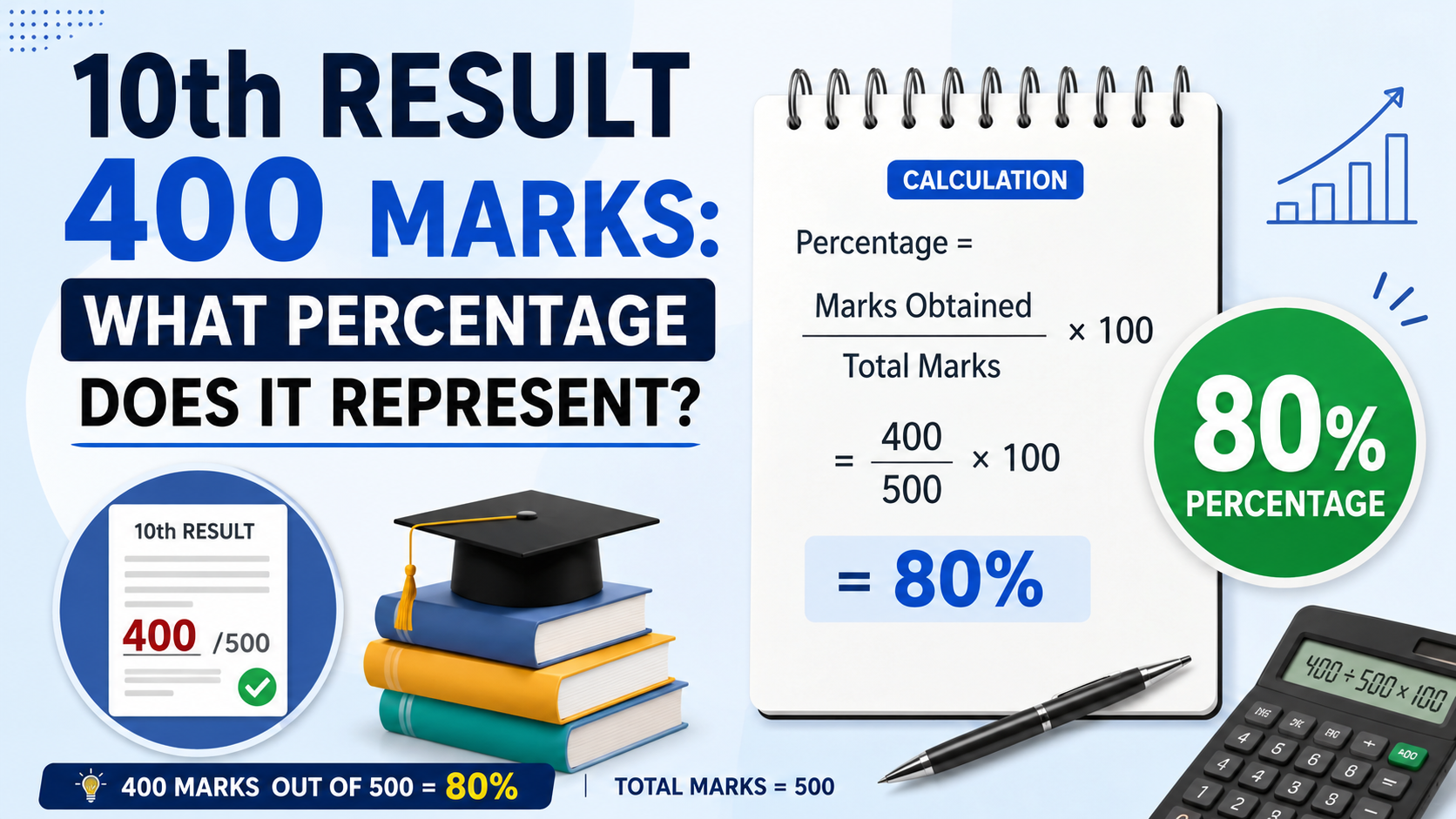
Percentage = (Marks Obtained ÷ Total Maximum Marks) × 100
For a total of 500 marks:
Percentage = (Marks Obtained ÷ 500) × 100
Because 500 divided by 100 is 5, there is a quick shortcut:
Percentage = Total Marks ÷ 5
Example 1: 425 Marks Out of 500
Percentage = (425 ÷ 500) × 100
Percentage = 85%
So, a student scoring 425 out of 500 has 85%.
Example 2: Subject-Wise Calculation
Suppose your marks are:
| Subject | Marks Obtained | Maximum Marks |
|---|---|---|
| English | 82 | 100 |
| Hindi | 78 | 100 |
| Mathematics | 91 | 100 |
| Science | 88 | 100 |
| Social Science | 86 | 100 |
| Total | 425 | 500 |
425 ÷ 5 = 85
Your percentage is 85%.
Percentage Table for 10th Result 500 Marks
This table provides quick conversions for common totals.
| Marks Out of 500 | Percentage |
|---|---|
| 500 | 100% |
| 475 | 95% |
| 450 | 90% |
| 425 | 85% |
| 400 | 80% |
| 375 | 75% |
| 350 | 70% |
| 325 | 65% |
| 300 | 60% |
| 275 | 55% |
| 250 | 50% |
| 200 | 40% |
| 165 | 33% |
For marks that are not shown in the table, divide the total by 5. For example:
- 438 out of 500 = 87.6%
- 367 out of 500 = 73.4%
- 294 out of 500 = 58.8%
Retain decimal places unless an application form specifically tells you how to round the percentage.
Percentage, Grade, and Pass Status Are Different
Students often use these terms interchangeably, but they serve different purposes.
Percentage
A percentage is a numerical conversion of your total marks. If you score 450 out of 500, your percentage is 90%.
It is useful when a school, scholarship, form, or employer specifically requests a percentage.
Grade
A grade is a board-defined indicator of performance in an individual subject or area. You should read the grade directly from the official marksheet rather than trying to create one from an internet grade chart.
For CBSE, the currently published secondary curriculum explains that Class X grades are awarded in each scholastic subject. It also describes Class X grading as positional: passed candidates are ranked and grades are awarded in octiles. This means a fixed online conversion such as “91–100 always equals A1” should not be treated as a guaranteed current CBSE Class X board-result rule. CBSE Secondary Curriculum 2025–26
Pass Status
Pass status depends on the applicable board rules and the marks or grades required in individual subjects. A high total cannot automatically compensate for a failed compulsory subject.
For CBSE, the published scheme states that marks and grades are awarded for individual subjects and that aggregate marks are not given. It also states the pass requirement in terms of the required performance in all five external subjects. CBSE Scheme of Examinations and Pass Criteria
How to Interpret Grades Correctly
The safest rule is simple: use the grade printed on your official marksheet and the rules of your own board.
Do Not Use a Generic Grade Chart as an Official Answer
Many websites display standard-looking grade tables. They can be useful for informal understanding, but they may be outdated, intended for another board, or applicable only to school-level assessment. Grade bands can differ by board, examination year, assessment type, and subject.
If an admission form asks for a grade:
- Enter the grade exactly as printed on the marksheet.
- Check the institution’s prospectus if it asks for a grade-to-percentage conversion.
- Contact the admission office when the form gives no conversion rule.
- Keep a scanned copy of the original marksheet and any official board guidance.
CBSE Students: Use Subject-Wise Marks and Grades
CBSE’s official material for Class X provides subject-specific marking schemes, while its examination rules state that the board does not provide an aggregate score. CBSE Class X marking schemes
Therefore, if you are a CBSE student, writing “percentage out of 500” is generally a personal or institution-requested calculation—not an aggregate officially issued by CBSE. Use it only where the school, college, scholarship, or application form asks for it.
Which Subjects Should Be Included?
Before calculating your 10th result percentage, identify the exact subjects to count. This matters most when you have an additional subject, vocational subject, or subject with a different maximum mark.
Use Five Main Subjects When Required
If the application explicitly asks for “best five,” “five main subjects,” or “percentage out of 500,” add the applicable five subjects and divide by 500 only if each is out of 100.
Do Not Automatically Include an Additional Subject
An additional subject may appear on the marksheet but may not be part of a five-subject total. Conversely, some institutions may permit it to replace a lower-scoring subject under their stated rules.
Never replace a subject merely to improve the percentage unless the receiving institution’s written eligibility or admission policy permits it.
Adjust the Formula When Marks Are Not Out of 100
If the subjects have different maximum marks, add the marks obtained and divide by the combined maximum marks.
For example, if your eligible subjects total 600:
Percentage = (Marks Obtained ÷ 600) × 100
Dividing by 5 would be incorrect in this situation.
Common Mistakes in 500 Marks Percentage Calculation
A correct calculation can still be rejected if the wrong subjects or denominator are used.
Dividing by the Wrong Total
If you include six subjects but still divide by 500, the result will be inaccurate. Count both the marks obtained and the maximum marks for the same set of subjects.
Adding Only Theory Marks
Where a subject’s final score includes theory, practical, project, or internal assessment, use the final subject total shown on the marksheet—not only the theory-paper score.
CBSE’s secondary curriculum includes a board-examination component and internal assessment for applicable subjects, so the final subject marks should be read from the official result document. CBSE Secondary Curriculum 2025–26
Treating Percentage as an Official Aggregate
A self-calculated percentage can be useful, but it does not override the marksheet. For CBSE students, this distinction is particularly important because the board’s scheme specifies subject-wise marks and grades rather than an aggregate.
Rounding Without Instructions
If your percentage is 84.6%, do not enter 85% unless the form asks you to round to the nearest whole number. Where no instruction is provided, using the exact percentage to two decimal places is usually clearer.
Using Your Class 10 Percentage for Admission
A Class 10 percentage may be requested for Class 11 stream selection, school admission, scholarships, or profile forms. Read each requirement carefully.
When submitting marks:
- Use the official marksheet as the primary document.
- Enter subject-wise marks where the form requests them.
- Calculate percentage only according to the form’s stated subject rule.
- Keep the calculation transparent: list the subjects, marks obtained, maximum marks, and final percentage.
- Check whether a stream or school has subject-specific requirements, such as Mathematics or Science marks, in addition to an overall percentage.
A strong total is useful, but subject performance often matters more for stream decisions. For example, a student considering Science with Mathematics should look closely at Mathematics and Science performance, alongside the school’s eligibility criteria.
Frequently Asked Questions
What is the percentage for 450 out of 500 in the 10th result?
450 out of 500 equals 90%.
(450 ÷ 500) × 100 = 90%
How do I calculate 10th percentage if I scored 387 out of 500?
Divide 387 by 5.
387 ÷ 5 = 77.4%
Your percentage is 77.4%.
Is 500 marks the same for every Class 10 board?
No. A total of 500 is common when five subjects are each out of 100, but boards and schools can use different subject combinations and maximum marks. Always calculate from the marks and maximum marks shown on your own result.
Can I use my best five subjects to calculate Class 10 percentage?
Only if the school, college, or application specifically permits “best five” or gives a rule allowing an additional subject to replace another subject. Otherwise, use the required subjects exactly as stated.
Does CBSE provide an overall percentage in the Class 10 marksheet?
CBSE’s published examination scheme states that marks and grades are awarded subject-wise and aggregate marks are not given. If an institution asks for a percentage, calculate it according to that institution’s specified subject rule and retain the official marksheet as the source document. CBSE Scheme of Examinations and Pass Criteria
Conclusion
For a 10th result 500 marks total, calculating percentage is easy: divide your obtained marks by 5. A score of 425 is 85%, 450 is 90%, and 500 is 100%.
The more important step is using the correct subjects and total maximum marks. Treat the official marksheet as final for marks, grades, and pass status, and calculate a five-subject percentage only when your school or application requires it.