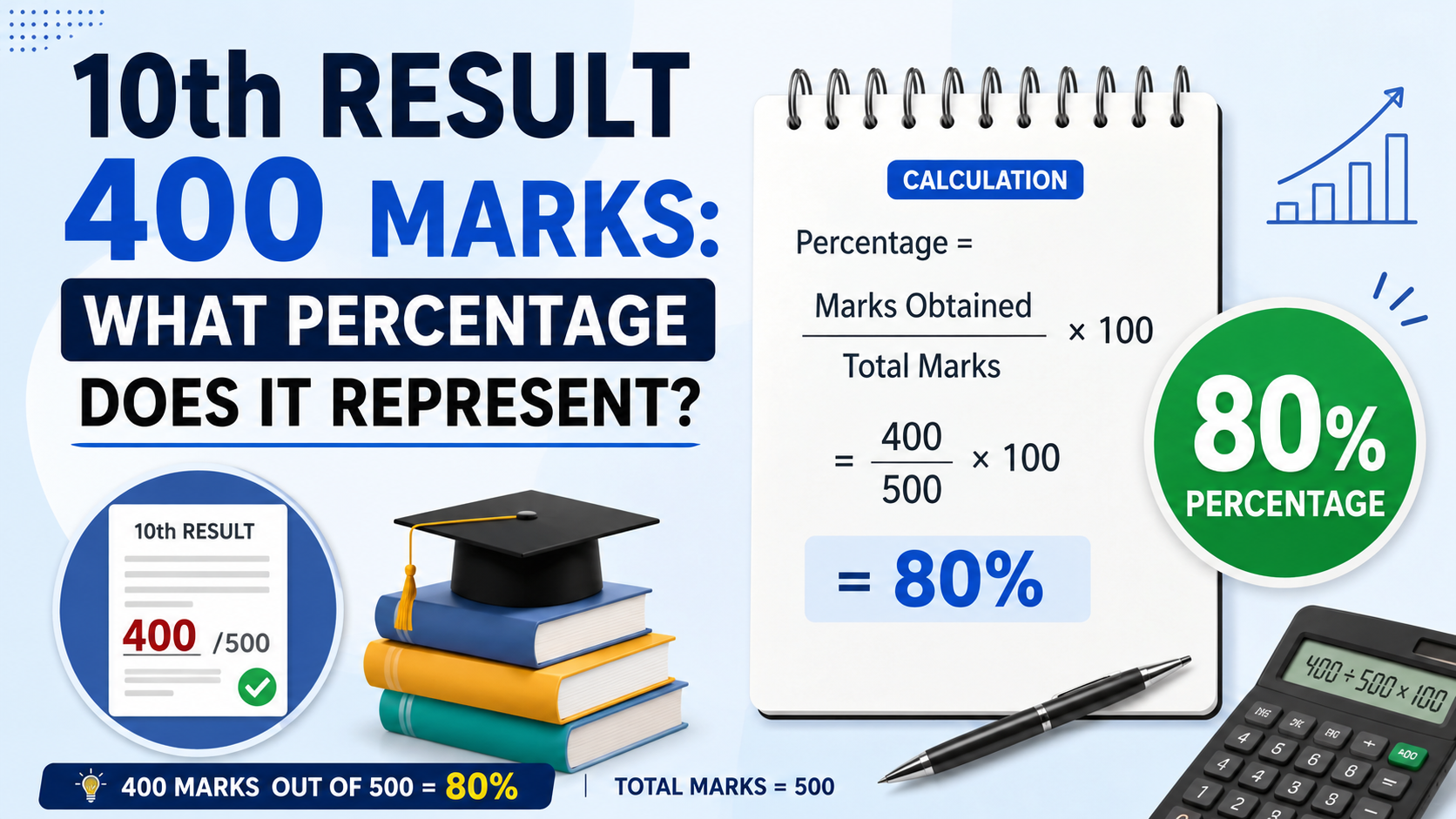
A 10th result 400 marks does not have one fixed percentage. The correct percentage depends entirely on the maximum marks considered. If your score is 400 out of 500, it is 80%. If it is 400 out of 600, it is 66.67%.
The calculation is simple, but Class 10 results can become confusing when students have six subjects, internal assessment marks, optional subjects, or a “best five” rule. This guide explains how to calculate your exact percentage, what 400 marks means under common totals, and how to use your marksheet correctly.
Key Takeaways
- 400 out of 500 equals 80%.
- 400 out of 600 equals 66.67%.
- Always divide by the maximum marks actually considered by your school, board, college, or application form.
- Do not automatically exclude a sixth subject or use best five unless the relevant institution permits it.
- A percentage is different from a pass result, grade, percentile, rank, or eligibility decision.
- Your official marksheet and the receiving institution’s admission rules are the final reference.
The Direct Answer: 400 Marks Equals What Percentage?
Use this formula:
Percentage = (Marks obtained ÷ Maximum marks) × 100
For 400 marks, the answer changes with the total marks.
| Marks obtained | Maximum marks | Percentage |
|---|---|---|
| 400 | 500 | 80% |
| 400 | 600 | 66.67% |
| 400 | 700 | 57.14% |
| 400 | 800 | 50% |
| 400 | 450 | 88.89% |
So, if you appeared in five subjects worth 100 marks each and scored 400 in total:
(400 ÷ 500) × 100 = 80%
This is the answer most students mean when they ask, “10th result 400 marks percentage?” However, it is correct only when the calculated total is 500.
How to Calculate Your Class 10 Percentage Correctly
The calculation takes only a few steps, but each one matters.
Step 1: Add the marks that should be counted
Read the subject-wise marks on your marksheet. Add only the subjects required for your purpose.
For example, consider these five subjects:
| Subject | Marks obtained | Maximum marks |
|---|---|---|
| English | 78 | 100 |
| Hindi | 76 | 100 |
| Mathematics | 82 | 100 |
| Science | 84 | 100 |
| Social Science | 80 | 100 |
| Total | 400 | 500 |
Step 2: Divide obtained marks by maximum marks
400 ÷ 500 = 0.80
Step 3: Multiply by 100
0.80 × 100 = 80%
Use the same method when subjects have different maximum marks. For instance, if one subject is out of 80 with 20 internal-assessment marks, use the final subject total shown on the marksheet—not only the theory-paper score.
A quick calculation shortcut
When the total is 500, divide your marks by 5:
400 ÷ 5 = 80%
This shortcut works only for marks out of 500.
Why 400 Marks Does Not Always Mean 80%
The number “400” tells you the marks obtained, not the denominator. A student with 400 marks may have appeared in five, six, or more counted subjects. That is why comparing raw marks without the total can be misleading.
400 out of 500: 80%
This is a common five-subject calculation. It indicates an average of 80 marks per subject.
400 out of 600: 66.67%
If six subjects of 100 marks each are included:
(400 ÷ 600) × 100 = 66.67%
400 out of 450: 88.89%
Some assessments or applications may use a different maximum total:
(400 ÷ 450) × 100 = 88.89%
The rule is straightforward: never assume a total of 500 because someone says “Class 10 marks.” Check the maximum marks printed on your result or specified by the institution.
Best Five, Six Subjects, and Optional Subjects: What Should You Count?
This is the most important practical issue in percentage calculation.
“Best of five” is not a universal board rule
Students often calculate their Class 10 percentage using the highest five subject scores. That may be useful for an institution that explicitly asks for best five, but it should not be treated as an automatic rule for every application.
For CBSE students, the Board issues a marksheet-cum-certificate showing marks obtained in each subject. Its 2025–26 List of Candidates information also states that where a student takes six or seven subjects and passes them, the percentage should be calculated according to the norms of the college or institution where admission is sought. CBSE’s official notice is a useful reminder that the receiving institution’s rule matters.
When a sixth subject may matter
A sixth subject may be relevant when:
- A school or junior college asks for aggregate marks in all listed subjects.
- A specific admission form tells you which subjects to include.
- The additional subject is used under an applicable board result rule.
- The admission process asks for a particular subject combination.
Do not replace a low score with an optional-subject score simply because it gives a higher percentage. Use that approach only if the relevant official rule or admission notice allows it.
Internal assessment and practical marks
Many Class 10 subjects combine theory and internal assessment, practical work, projects, or other components. For example, CISCE’s published ICSE regulations show subject structures with external examination and internal assessment components; the final subject score should be read as a whole. CISCE ICSE Regulations
For percentage purposes, use the final marks awarded for each subject on the official marksheet. Do not calculate only from theory marks unless an application specifically asks for theory marks.
Board-Wise Context: Read the Marksheet Before Calculating
India has multiple school boards and state boards, so there is no single Class 10 percentage convention that fits every student.
CBSE Class 10 students
CBSE publishes subject-wise Class X marking schemes, and the available subjects can include languages, core subjects, skill subjects, and optional subjects. CBSE’s Class X marking-scheme page should be consulted for the relevant examination year and subject.
For admissions, follow the school, college, scholarship, or form instructions on whether it wants:
- Five main subjects,
- All subjects listed,
- Best five subjects,
- A specified subject combination, or
- Marks in particular compulsory subjects.
ICSE students
ICSE subject selection can span Group I, Group II, and Group III subjects. The Council’s regulations set out the assessment pattern and subject structure. Because applications may prescribe their own calculation method, use the final marksheet and the receiving institution’s stated criteria rather than assuming that every subject will be treated identically.
State-board students
State boards may use different subject totals, languages, vocational subjects, grading formats, and aggregate methods. Your marksheet is the primary document. If it shows total marks and percentage, use those details unless an application provides a different calculation instruction.
Percentage, Grade, Percentile, and Pass Status Are Different
A percentage is useful, but it is not the same as every other result term.
| Term | What it means |
|---|---|
| Percentage | Marks obtained as a share of maximum marks |
| Grade | A performance band assigned under a board’s grading system |
| Percentile | Your relative position compared with other candidates; it is not your percentage |
| Pass status | Whether you meet the board’s qualifying requirements |
| Rank | Your position among candidates, where ranks are issued |
An 80% score does not mean the 80th percentile. Likewise, a student may have a strong overall percentage but still need to satisfy subject-specific eligibility requirements for a course.
How to Use 400 Marks in Applications and Admissions
Once you have calculated your percentage, present it exactly and transparently.
Write it in the correct format
If your score is 400 out of 500, write:
Class 10 aggregate: 400/500 (80%)
If the application requests six subjects and you have 400 out of 600, write:
Class 10 aggregate: 400/600 (66.67%)
This makes the calculation clear and avoids confusion.
Follow the application’s wording
Before filling a form, look for terms such as:
- “Aggregate percentage”
- “Best five subjects”
- “Main subjects”
- “Marks including additional subject”
- “Marks excluding optional subject”
- “Overall percentage as per marksheet”
If a college requires Mathematics, Science, and English separately, meeting the overall percentage alone may not be enough.
Keep the official document unchanged
Do not alter, round up, or manually create a different percentage on an official record. If a form permits two decimal places, write 66.67% for 400 out of 600. If it accepts only whole numbers, follow its stated rounding instruction; if none is provided, seek clarification from the institution.
Common Mistakes to Avoid When Calculating Percentage
A small calculation error can affect how a score appears in an application.
- Assuming 400 marks always equals 80%: It does only when the total is 500.
- Ignoring internal assessment: Use the final marks awarded in each subject.
- Using best five without permission: A higher self-calculated percentage may not be accepted.
- Adding marks from subjects with different maximums incorrectly: Add both obtained marks and maximum marks before calculating.
- Confusing percentage with percentile: They measure different things.
- Rounding too early: Calculate first, then round only at the end if required.
- Relying on unofficial calculators: Cross-check with your marksheet and the institution’s instructions.
Frequently Asked Questions
Is 400 out of 500 good in Class 10?
400 out of 500 is 80%. Whether it is considered suitable depends on the course, school, scholarship, or junior college you are applying to. Eligibility criteria can differ by institution and may include subject-wise requirements.
What is 400 out of 600 in percentage?
400 out of 600 is:
(400 ÷ 600) × 100 = 66.67%
Can I calculate Class 10 percentage using best five subjects?
Use best five only when your school, board guidance, college, or application form specifically permits it. Otherwise, calculate using the subjects and total marks the receiving institution requires.
Should I include an additional or optional subject in my percentage?
Not automatically. Check the application instructions. CBSE specifically directs students with six or seven subjects to calculate percentage according to the norms of the institution where they seek admission.
Does 400 marks guarantee admission to a particular Class 11 stream?
No. Admission depends on the school or college’s current criteria, seat availability, subject-wise marks, category rules where applicable, and its own selection process. Check the institution’s official admission notice before applying.
Conclusion
A 10th result 400 marks equals 80% only when the maximum total is 500. If the total is 600, the same score equals 66.67%; if it is 450, it equals 88.89%. Start with the official marksheet, identify the exact subjects and maximum marks that count, then apply the formula: marks obtained divided by maximum marks, multiplied by 100.
Before using your percentage for Class 11, scholarships, or any admission form, read that institution’s instructions carefully—especially where best five, optional subjects, or subject-specific eligibility are involved.