An sslc result grade percentage calculator helps students convert subject-wise marks into an overall percentage and understand how that score may relate to a grade. The calculation itself is simple, but SSLC is not governed by one nationwide marking scheme. Karnataka, Kerala, Tamil Nadu, and other state boards can use different subjects, maximum marks, internal-assessment rules, grading scales, and result formats.
The right approach is to calculate your percentage from the exact marks and maximum marks printed on your own marks card, then use the grade scale issued by your board. This guide explains the process, including how to handle unequal subject totals, grades without marks, supplementary exams, and official-result checks.
Key Takeaways
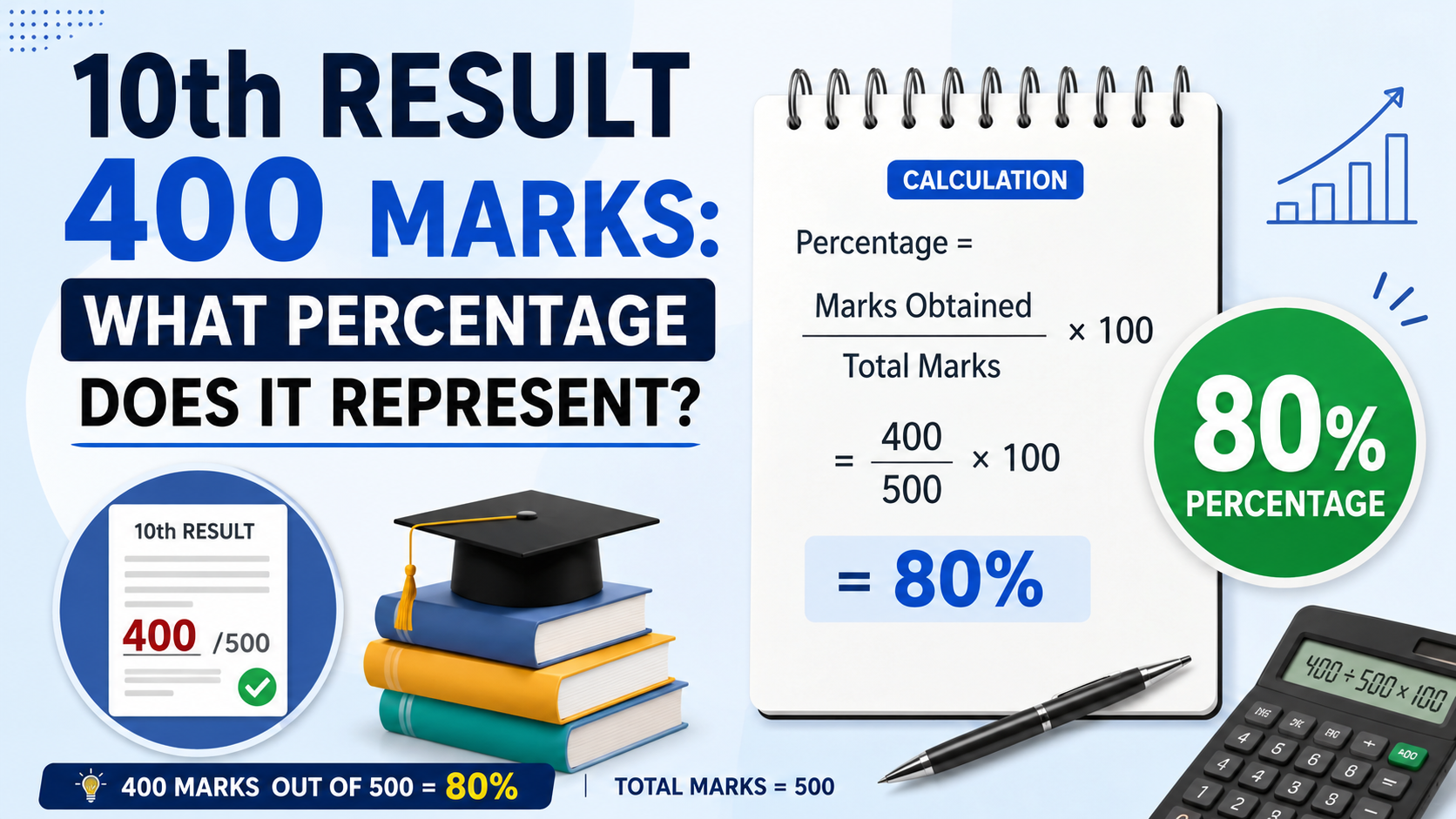
- Calculate percentage as total marks obtained ÷ total maximum marks × 100.
- Add only the subjects that your board includes in the aggregate.
- Do not assume every SSLC student has the same total maximum marks or grade bands.
- Use the marks card’s subject-wise maximum marks, especially where practicals or internal assessment apply.
- A grade and a percentage are not always interchangeable; follow the board’s official grade scale.
- Treat online results as provisional information unless the board states otherwise; rely on the original marks card for formal use.
What an SSLC Percentage Actually Represents
SSLC commonly refers to the Secondary School Leaving Certificate examination at Class 10 level. However, “SSLC percentage” does not have one fixed national definition.
Your overall percentage usually represents the share of marks you obtained out of the maximum marks considered for the result:
[ \text{Percentage} = \left(\frac{\text{Total marks obtained}}{\text{Total maximum marks}}\right) \times 100 ]
For example, a student who scores 438 out of 500 has:
[ \left(\frac{438}{500}\right) \times 100 = 87.6\% ]
The calculation is mathematically the same across boards. What changes is the input:
- Number of subjects included
- Maximum marks per subject
- Whether internal assessment is included
- Whether an additional language, skill subject, or elective is included in the aggregate
- Whether the result shows marks, grades, or both
- Whether the board uses the best score from multiple examinations
This is why a generic online calculator can be useful for arithmetic but cannot decide which subjects count in your official aggregate.
How to Calculate Your SSLC Percentage Step by Step
Before entering anything into an SSLC result grade percentage calculator, keep your official or provisional marks card in front of you.
Step 1: List only the relevant subjects
Write down every subject that is included in your board’s aggregate. Do not automatically include every item displayed on the marks card.
Some marks cards may show:
- Main academic subjects
- First, second, or third language
- Internal assessment
- Practical components
- Co-curricular activities
- Skill or vocational subjects
- Additional subjects
- Grade-only subjects
A subject labelled “additional” or shown only as a grade may not necessarily count towards the overall result. Check the notes on the marks card and your board’s current rules before adding it.
Step 2: Record marks obtained and maximum marks
Create a simple table. Use the maximum marks printed for each subject instead of assuming that all subjects are out of 100.
| Subject | Marks Obtained | Maximum Marks |
|---|---|---|
| Language 1 | 78 | 100 |
| Language 2 | 82 | 100 |
| Mathematics | 91 | 100 |
| Science | 86 | 100 |
| Social Science | 89 | 100 |
| Total | 426 | 500 |
Step 3: Add the marks correctly
Add the values in the “Marks Obtained” column. Then separately add the values in the “Maximum Marks” column.
In the example:
- Total obtained = 78 + 82 + 91 + 86 + 89 = 426
- Total maximum = 500
Step 4: Apply the percentage formula
[ \left(\frac{426}{500}\right) \times 100 = 85.2\% ]
The student’s overall percentage is 85.2%.
Step 5: Round only if needed
Keep one or two decimal places unless an application form, school, college, or employer specifies a rounding rule.
For instance:
- 85.246% can be shown as 85.25% to two decimal places.
- If a form accepts whole numbers only, follow its instructions rather than rounding arbitrarily.
Never change the underlying marks to make the result look cleaner.
Using an SSLC Result Grade Percentage Calculator
A calculator should save time, not replace the information on your marks card. Use one with fields for both marks obtained and maximum marks, rather than one that assumes every subject is out of 100.
What to enter
Enter:
- Marks obtained in each included subject
- Maximum marks for that subject
- Any officially awarded internal-assessment marks, where they are already part of the final subject total
- Only the subjects permitted in the aggregate
The calculator should add the marks and return:
- Total obtained marks
- Total maximum marks
- Percentage
- Optional grade, if you enter a board-specific grade scale
Why unequal maximum marks matter
Consider this result:
| Subject | Marks Obtained | Maximum Marks |
|---|---|---|
| Language | 74 | 100 |
| Mathematics | 68 | 80 |
| Science | 71 | 80 |
| Social Science | 75 | 80 |
| Internal assessment | 18 | 20 |
| Total | 306 | 360 |
[ \left(\frac{306}{360}\right) \times 100 = 85\% ]
A common mistake would be to add the five obtained scores and divide by 500. That would be incorrect because the listed subjects are collectively out of 360, not 500.
How to Interpret Grades Alongside Percentage
Grades are labels assigned to a range of performance. A percentage is a numerical calculation. They are related only when your board publishes a grade-to-mark or grade-to-percentage scale.
For example, a marks card may show:
- Subject-wise marks and grades
- Only subject-wise grades
- An overall result without a single overall grade
- Different grading treatment for academic and co-curricular subjects
Do not use a grade chart from another state board, school board, or older academic year to interpret your result. A grade such as A, A+, B+, or C may not represent the same percentage everywhere.
When the marks card shows both marks and grades
Use marks to calculate the percentage. Use the grade as a separate performance indicator.
If the grade shown by your board appears different from a grade you expected from an online chart, the board-issued grade is the relevant one. Your marks card and the board’s published rules take priority over calculator results.
When the marks card shows grades only
You may not be able to calculate an exact percentage. A grade range does not reveal the exact marks within that range.
For example, if a grade represents a range, two students with the same grade could have different actual marks. Do not claim an exact percentage unless your board provides an authorised conversion method.
Common SSLC Percentage Calculation Errors
A careful calculation prevents problems in admissions, scholarship forms, and document submissions.
Adding an excluded subject
An additional language, vocational component, or skill subject may be reported separately. Including it without checking can change the percentage.
Ignoring different maximum marks
Always divide by the actual total maximum marks. This is especially important when theory, practical, and internal components have different weightage.
Double-counting internal assessment
If your final subject mark already includes internal assessment, do not add the internal score again. Use the final subject total printed on the result.
Confusing pass status with percentage
Passing every subject and achieving a particular aggregate percentage are separate matters. A student may satisfy the pass requirement without meeting a college’s preferred percentage threshold.
Converting grades using an unofficial chart
Unofficial conversion charts can be inaccurate or outdated. Ask the receiving institution what it accepts if an application specifically requests a percentage from a grade-based marks card.
Using the wrong examination attempt
If your board publishes a consolidated result after multiple examinations, use the marks shown on the final consolidated marks card. Do not manually combine scores from different attempts unless the board explicitly instructs you to do so.
Official Result and Marks Card: What to Trust
Use only your state board’s official result portal and documents when confirming an SSLC result.
For Karnataka, the National Informatics Centre’s official result portal identifies the Karnataka School Examination and Assessment Board as the result authority and publishes SSLC result links. Its 2026 SSLC consolidated-result page refers to the best marks from Exam 1 and Exam 2, so candidates should use the final result record applicable to their attempt rather than calculate an aggregate from older scorecards. Karnataka Examination Results
For Kerala, the official KITE SSLC result portal states that online results are for immediate information and that the original marksheet is issued separately by the Board of Public Examinations. Kerala SSLC Examination Results
This distinction matters when you are applying for Class 11 admission, certificates, scholarships, or other official purposes:
- Use the online result to check marks promptly.
- Download or print it only as a temporary reference where permitted.
- Collect and preserve the original marks card.
- Match your name, register number, date of birth, subject marks, result status, and any remarks.
- Contact your school or the board promptly if a discrepancy appears.
Practical Examples for Different Mark Structures
Example 1: Five equal subjects
A student scores 92, 81, 77, 88, and 84, with each subject out of 100.
[ \frac{92+81+77+88+84}{500} \times 100 ]
[ \frac{422}{500} \times 100 = 84.4\% ]
Percentage: 84.4%
Example 2: Six subjects with different maxima
A student scores 76/100, 65/80, 68/80, 71/80, 73/80, and 18/20.
- Total obtained = 371
- Total maximum = 440
[ \left(\frac{371}{440}\right) \times 100 = 84.318\ldots\% ]
Percentage: 84.32% when rounded to two decimal places.
Example 3: Grade-only result
A student receives subject grades but no marks. An exact percentage cannot be calculated merely by assigning assumed numbers to each grade. The student should use the official grade interpretation or seek a conversion certificate only if the board or receiving institution provides a recognised process.
Frequently Asked Questions
Can I calculate my SSLC percentage by adding all subject marks?
Yes, but only after confirming that every added subject is included in the official aggregate. Divide the total obtained marks by the total maximum marks for those same subjects, then multiply by 100.
Is SSLC percentage always calculated out of 500?
No. The total depends on the board’s scheme, subjects, and assessment structure. Use the maximum marks printed on your marks card rather than assuming a total of 500, 600, or any other figure.
Can I convert an SSLC grade into an exact percentage?
Not always. If the result gives only grades, an exact percentage is possible only when the relevant board provides an official conversion formula or exact equivalent.
Should I include internal assessment marks in my calculation?
Include them only once. If the marks card shows a final subject score that already combines theory and internal assessment, use that final score. If components are listed separately and are officially part of the subject total, add them according to the board’s format.
Which result should I use after a supplementary or improvement examination?
Use the final marks card or consolidated result issued by your board. Do not assume that marks from separate attempts should be added together unless the official result explicitly reflects that method.
Conclusion
An ssLC result grade percentage calculator is most accurate when it uses the exact subject marks and maximum marks from your own board-issued record. Add only the subjects included in the official aggregate, divide by the correct total maximum marks, and treat grades according to your board’s published scale.
Before using the percentage for admission or any formal application, compare it with your final marks card and the receiving institution’s eligibility rules.